PUBLISHED FIDELITY REPORT ✦ 18 CONFIGURATIONS ✦ METAQUOTES 1M USDJPY ✦ 18 OF 18 TESTS EXACT ✦ 3,790 TRADES, ZERO DRIFT ✦ 100% MECHANISM ALIGNMENT ✦ REPRODUCIBLE BY ANY MT5 USER ✦ PUBLISHED FIDELITY REPORT ✦ 18 CONFIGURATIONS ✦ METAQUOTES 1M USDJPY ✦ 18 OF 18 TESTS EXACT ✦ 3,790 TRADES, ZERO DRIFT ✦ 100% MECHANISM ALIGNMENT ✦ REPRODUCIBLE BY ANY MT5 USER ✦

Lattice Command

The most advanced order-network execution system on MQL5 — and we publish the proof. Lattice Command is the live execution layer of the Lattice Suite. Load the parameters you discovered in Lattice Vision, deploy them with full risk-control architecture intact, and run them on a tested engine whose fidelity to the analysis layer is documented openly with publicly verifiable data.

Buy on MQL5 — $149 USD Read the Fidelity Report →

Lattice Command™ is execution automation software developed by Cave and Fire Group Pty Ltd. It does not generate trading signals, provide financial advice, or guarantee any outcome.

Lattice Command

Software Disclosure: Cave & Fire Lab is a trading name of Cave and Fire Group Pty Ltd., a software development company. We are not a financial services provider, broker, fund manager, or advisory firm. We do not provide financial advice, trading signals, or recommendations of any kind. Our products are software tools that automate user-defined parameters. All configuration, deployment decisions, and trading outcomes are the sole responsibility of the user.

What It Does

Lattice Command is the execution half of the Lattice Suite. Once you've shaped and validated your parameters with Lattice Vision, Command is how you actually deploy them — first through proper backtesting in the MetaTrader 5 strategy tester, then forward testing, and ultimately live execution with real capital.

Most automated systems fail in production not because the underlying logic is flawed, but because they don't handle the reality of execution: disconnections, slippage, partial fills, broker inconsistencies, server restarts. Command is engineered from the ground up to handle all of it. Hardened persistent state means the software always knows exactly where it is, even after a crash or restart — no orphaned positions, no duplicate orders, no confused state.

Two decades of observing how systems fail in live environments has informed every design decision. This is production-grade software built from real operational experience — specifically engineered to survive the things that commonly go wrong.

Command includes a full Signal Mode that gates lattice builds using market signals — RSI, DeMarker, Stochastic, MA Touch/Cross/Angle, MACD, Engulfing, or Pin Bar — on any timeframe, with cross or territory trigger modes and configurable cooldowns per side. A four-slot Entry Filter System gates individual order triggers independently per side. Direction Mode lets you restrict execution to buy-only, sell-only, or both sides of the network. These are the refinement tools that transform a raw order network into a condition-aware system.

Like all Cave & Fire Lab software, the logic is fully transparent. Detailed on-chart dashboard, execution state indicators, and comprehensive logging mean you can see exactly what the engine is doing, why it's doing it, and verify it matches your expectations at all times.

Full order network on chart

Your order network is visualised on chart with basic horizontal lines hidden from the market — Ghosting, awaiting further price interaction

Ghosting Technology™

Ghosting Technology™ is a proprietary trigger-filtering system shared across the entire Lattice Suite — and it fundamentally changes how order networks engage with the market.

The problem: when price first enters an order network, the initial interactions are often noise. Traditional networked-order systems execute on every crossing indiscriminately, building early exposure during unstable conditions before the market has committed to a direction. That premature positioning can drag the entire basket into an unfavourable state before the real move even begins.

Ghosting Technology™ defines a configurable threshold of initial interactions that are tracked but not executed. These "ghost" triggers count toward the basket lifecycle and appear on the chart as distinct visual markers, but no order is placed. Only after the ghost threshold is exceeded do subsequent interactions trigger real execution. The result is an intelligent positioning phase that filters out noise and lets your network engage when price has demonstrated real commitment.

The ghosting logic is identical between Vision and Command. The ghost count you discovered works best during visual analysis produces exactly the same filtering behaviour when executing live orders. No surprises. No discrepancy. This is the continuity that makes the Lattice Suite work as a genuine pipeline from analysis to deployment.

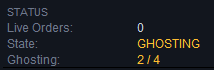
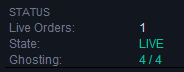
Ghosting state active

Ghosting state active — 4 of 4 ghost triggers tracked, zero live orders.

Signal Mode

Signal Mode transforms Lattice Command from a pure price-interaction system into a condition-aware execution engine. Instead of building the lattice on a fixed time interval, lattice builds are triggered by market signals — giving you genuine confluence between your order network and market conditions.

Nine signal types are supported: RSI, DeMarker, Stochastic, MA Touch, MA Cross, MA Angle, MACD, Engulfing candle, and Pin Bar. Sell-side and buy-side signals are configured independently — different types, different timeframes, different thresholds. Each signal has its own period, secondary period (where applicable), and sensitivity setting.

Two trigger modes control when the signal fires. Cross mode fires once when price crosses the threshold — a clean, one-shot trigger. Territory mode continues firing while price remains inside the zone, allowing the basket to keep building as long as conditions hold. A configurable cooldown prevents rapid re-triggering between fires. Signal parameters load directly from your Lattice Vision .SET file — no manual re-entry.

Direction Mode

A single parameter cycles between three execution modes: BOTH (full two-sided network — the default), BUY ONLY (lower lines only), and SELL ONLY (upper lines only). Apply a directional bias without touching any other parameter.

Use it to align the network with a directional thesis, restrict exposure during one-sided market conditions, or run pure trend-following configurations. Direction Mode loads directly from your Lattice Vision .SET file, so the bias you discovered in Vision is the bias you deploy with Command.

Entry Filter System

Four independent filter slots — two sell-side, two buy-side — gate individual order triggers based on market conditions. Each slot supports four filter types: SMA (price relative to moving average), RSI, DeMarker, and Stochastic. Every slot has its own type, period, timeframe, threshold range, and reverse-logic option.

Two filter modes control how conditions are evaluated. All mode requires the filter condition to be met on every trigger throughout the basket lifecycle. Cross mode fires only on fresh threshold crossings. Combine two filter slots per side for multi-condition confirmation — for example, an SMA directional check and an RSI momentum gate. A global signal cooldown prevents rapid re-triggering across all filter conditions.

All filter settings load directly from your Lattice Vision .SET file. The filter conditions you tested in Vision are the exact conditions Command enforces in live execution.

Ready to deploy?

Lattice Command on the official MQL5 Marketplace. One-time purchase, free updates.

Buy on MQL5 — $149
(5 years of data in 5 minutes — watch Leon's settings discovered in Lattice Vision at work )

Instant Parallel Close

When a basket hits its target threshold, speed matters. In fast-moving markets, the difference between closing all positions instantly versus closing them one-by-one can be the difference between locking in profit and watching it evaporate.

Lattice Command's parallel close fires closure requests for all active positions simultaneously rather than sequentially. Traditional sequential closing means each position waits for the previous one to confirm before the next request is sent — and in a basket with multiple positions, that delay can cost significant slippage as price moves against you during the closure process.

Parallel close eliminates that problem. All positions receive their closure instructions at the same moment, minimising the window of exposure during the critical closing phase. This is especially important during volatile conditions, news events, or any scenario where price is moving rapidly.

The feature is configurable — you can enable parallel close for maximum speed or disable it to use sequential closing if your broker or account type handles it better. Either way, you're in control.

The Lattice Suite — One Workflow, Two Tools

Lattice Vision and Lattice Command share the same underlying engine: identical lattice construction, identical Ghosting Technology™, identical distance modes, and identical parameter definitions. Settings transfer directly between them with complete fidelity — no translation layer, no configuration mismatch.

Step 1: Discover & Shape (Vision)

Rapidly explore configurations across historical data. Adjust distances, lot sizes, ghost counts, targets, and distance modes. Observe basket behaviour, drawdown characteristics, and outcome patterns across years of data in real time. Save promising configurations to presets.

Step 2: Backtest & Refine (Command)

Transfer your discovered settings to Command. Run proper bar-by-bar backtests in the MT5 strategy tester with the full execution engine — including advanced trigger options like consolidated execution, recross confirmation, and Ghosting Technology™ operating with real order management. Refine your ghost count, test parallel close, and validate risk safeguards.

Step 3: Forward Test & Deploy (Command)

Deploy with Command's hardened architecture — persistent state recovery, multi-layer risk safeguards, adaptive broker compatibility, instant parallel close, and 24/7 VPS reliability. The same parameters, the same ghosting logic, the same lattice behaviour — now executing real orders with production-grade resilience.

Execution Engine

20-Level Order Network

Up to 20 configurable execution levels — 10 upper (sell) and 10 lower (buy). Independent spacing and independent lot sizing per level. The same structure you shaped in Vision, now executing real orders. Supports uniform lattice shapes, progressive configurations, asymmetric layouts, or any custom design.

Dual Distance Modes

PIPS Mode: Fixed pip-based spacing — constant distances regardless of market conditions. ATR Mode: Adaptive spacing using Average True Range over a configurable lookback period. Distances automatically expand in volatile markets and contract in quiet ones. In ATR mode, the basket target threshold is also expressed in ATR multiples and converted to account currency at the point of lattice construction. Both modes match Vision exactly.

Consolidated Execution

When price moves fast and crosses multiple lattice levels within a single bar, Command can consolidate what would have been several separate orders into fewer, larger ones. This reduces position count while maintaining proportional exposure — fewer open trades to manage, same net effect. Configurable thresholds determine when consolidation kicks in.

Recross Confirmation

An additional confirmation layer that delays execution until price re-interacts with a triggered level. Instead of executing immediately when price crosses a line, the system waits for price to come back and cross it again — filtering out fast spikes that touch a level once and never return. Can be combined with consolidated execution and ghosting for highly refined trigger behaviour.

Direction Inversion

Reverse the execution direction with a single parameter. Upper crossings execute buy orders, lower crossings execute sell orders. Deploy contrarian configurations that were validated in Vision's reverse mode. The inversion is applied cleanly at the execution layer without changing the underlying lattice logic.

Periodic Lattice Recalibration

The order network automatically recentres on the SMA reference at configurable intervals. When no basket is active, the lattice stays fresh and aligned with current price structure rather than anchored to a stale level. Optional lattice locking prevents recalibration during an active basket. Identical logic to Vision.

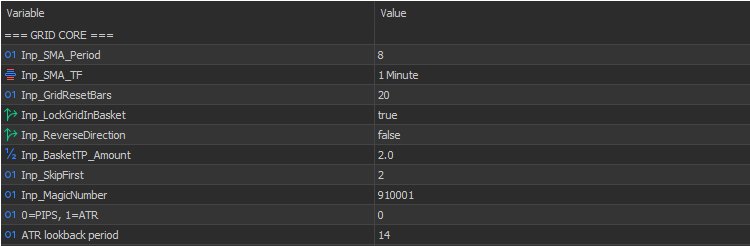
Lattice Core Settings

Lattice core settings panel

SMA period, timeframe anchoring, lattice reset interval, basket target, skip-first filtering, magic number, distance mode selection, and ATR lookback — all configurable per-instance.

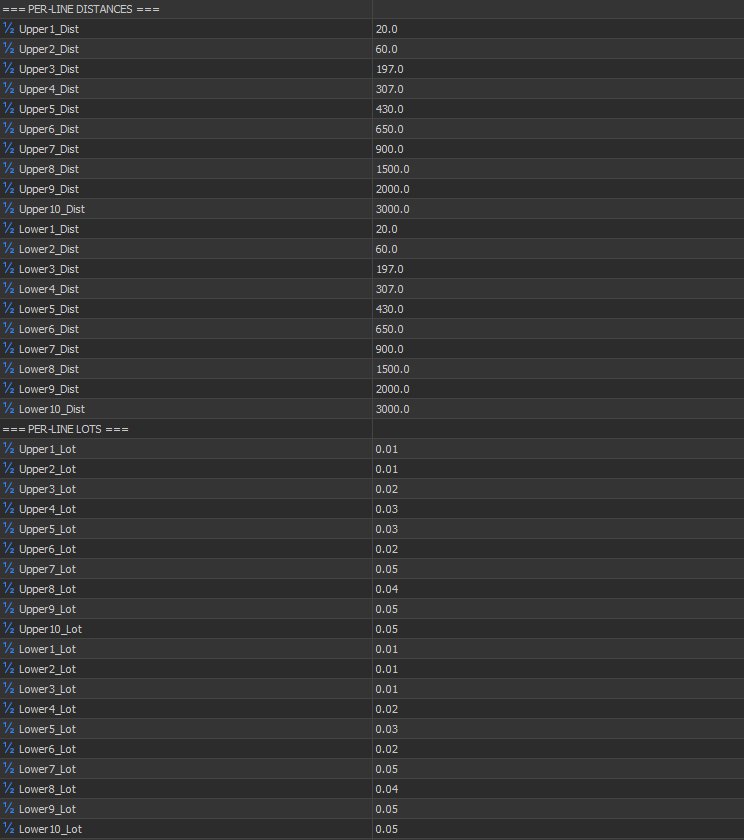
Per-Line Distances

Per-line distance and lot configuration

Independent upper and lower distances for all 10 levels per side, plus independent lot sizing per level — complete asymmetric control.

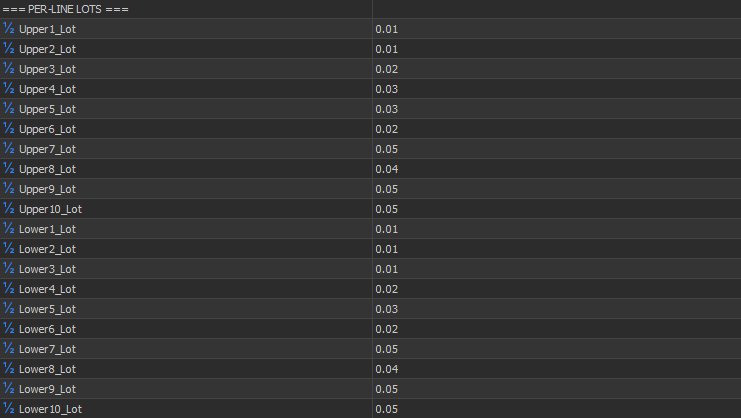
Per-Line Lot Sizing

Per-line lots for upper and lower sides

Fully independent lot sizes for every level — upper and lower. Build progressive, regressive, or custom exposure profiles.

(See the full execution engine in action — Leon's real configuration running live in the demo )

Risk Control Architecture

Equity-Based Soft Stop

Continuously monitors account equity against a configurable drawdown threshold. When the limit is reached, all positions are liquidated automatically, internal state is reset, and execution is temporarily suspended until recovery conditions are met. This is your automated circuit breaker — it acts when you can't.

Broker-Level Hard Stop

Applies a unified broker-side stop-loss across all active positions based on aggregate loss limits. Unlike the soft stop which monitors equity, the hard stop places actual SL orders with the broker — providing protection even if the EA loses connectivity, the terminal crashes, or the VPS goes down. On trigger, execution halts completely until manual intervention.

Spread Guard

Orders are blocked when the live spread exceeds your configured maximum point threshold. Prevents execution during illiquid conditions, news spikes, or abnormal widening events. Checked on every order attempt. Only active when Live Mode is enabled.

Live Mode Flag

An explicit activation switch required before real orders are placed. Prevents accidental live deployment during configuration, backtesting, or parameter adjustment. Clear separation between analysis mode and live execution mode.

Pre-Execution Margin Validation

Every order is checked against available free margin before submission. If the margin required would exceed 95% of available free margin, the order is blocked. Prevents margin call scenarios from being triggered by the EA itself.

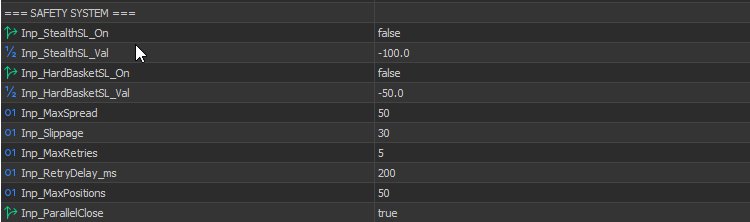
Safety System Configuration

Safety system settings

Stealth SL, hard basket SL, max spread filter, slippage control, retry logic, max positions, and parallel close — layered protection you configure once and trust.

Production Hardening

Persistent State Recovery

The software's full operational state is preserved continuously: active lattice positions, basket cycle data, trigger states, ghost progress, chart annotations, session statistics, and execution history. Terminal crash? VPS restart? Power failure? Command resumes exactly where it left off. No orphaned positions. No duplicate orders. No confused state.

Adaptive Broker Compatibility

Automatically detects broker execution modes (instant, market, exchange), fill policies (FOK, IOC, return), and lot constraints (minimum, maximum, step). Normalises all volumes to broker requirements without manual configuration. Tested across ECN, STP, and market-maker environments. Works out of the box.

Intelligent Retry Handling

When orders fail, Command doesn't just retry blindly. It differentiates between temporary failures (requotes, price changes, timeouts) that warrant retries and permanent failures (market closed, invalid parameters) that don't. Configurable retry count and delay. Every failure is logged with the specific reason.

Connection Health Monitoring

Continuous monitoring of connection state and quote freshness. Stale-quote detection prevents execution on outdated prices. Automatic reconnection handling ensures the EA recovers gracefully from network interruptions without manual intervention.

(Watch the demo — 5 years of basket cycles from Leon's Lattice Vision discovery, deployed and running )

Market Hours & Consolidation

Market Hours Guard

Order placement is automatically blocked during market close windows — specifically the 23:xx and 00:xx hours when liquidity is thin and spreads widen. No manual configuration required. This guard is built into the execution layer and matches the same restriction applied in Lattice Vision's simulation, keeping backtest and live trade counts aligned.

Skipped Line Consolidation

When a filter or direction setting causes a lattice level to be bypassed, Skipped Consolidation tracks those missed interactions and can roll them into a single consolidated trigger once a minimum count is reached. Configurable minimum line threshold. The same consolidation logic runs in Lattice Vision, so behaviour matches your simulation exactly.

Skipped Consolidation

Skipped consolidation settings

Control whether skipped levels are consolidated and minimum line thresholds for consolidation behaviour.

On-Chart Dashboard

Real-Time Status Panel

Live display of aggregate basket PnL (colour-coded positive/negative), cumulative session profit, maximum observed drawdown, peak margin usage, active position count, ghost progress indicator, and execution state — all updating on every bar. The panel is draggable and respects the Show Drawings toggle. Bloomberg-inspired terminal aesthetic designed for extended monitoring sessions.

Execution State Indicators

Clear status labels show exactly what the engine is doing: IDLE — awaiting interaction. GHOSTING — ghost phase active. LIVE — executing real positions. HARD STOP — hard stop engaged, awaiting manual resume. No ambiguity about what's happening at any moment.

Basket History

The last 20 completed basket cycles are logged in the panel — timestamp, PnL, lot exposure, and trigger count per cycle. Review recent performance without leaving the chart. The Resume button appears automatically when a hard stop is engaged, and disappears once cleared.

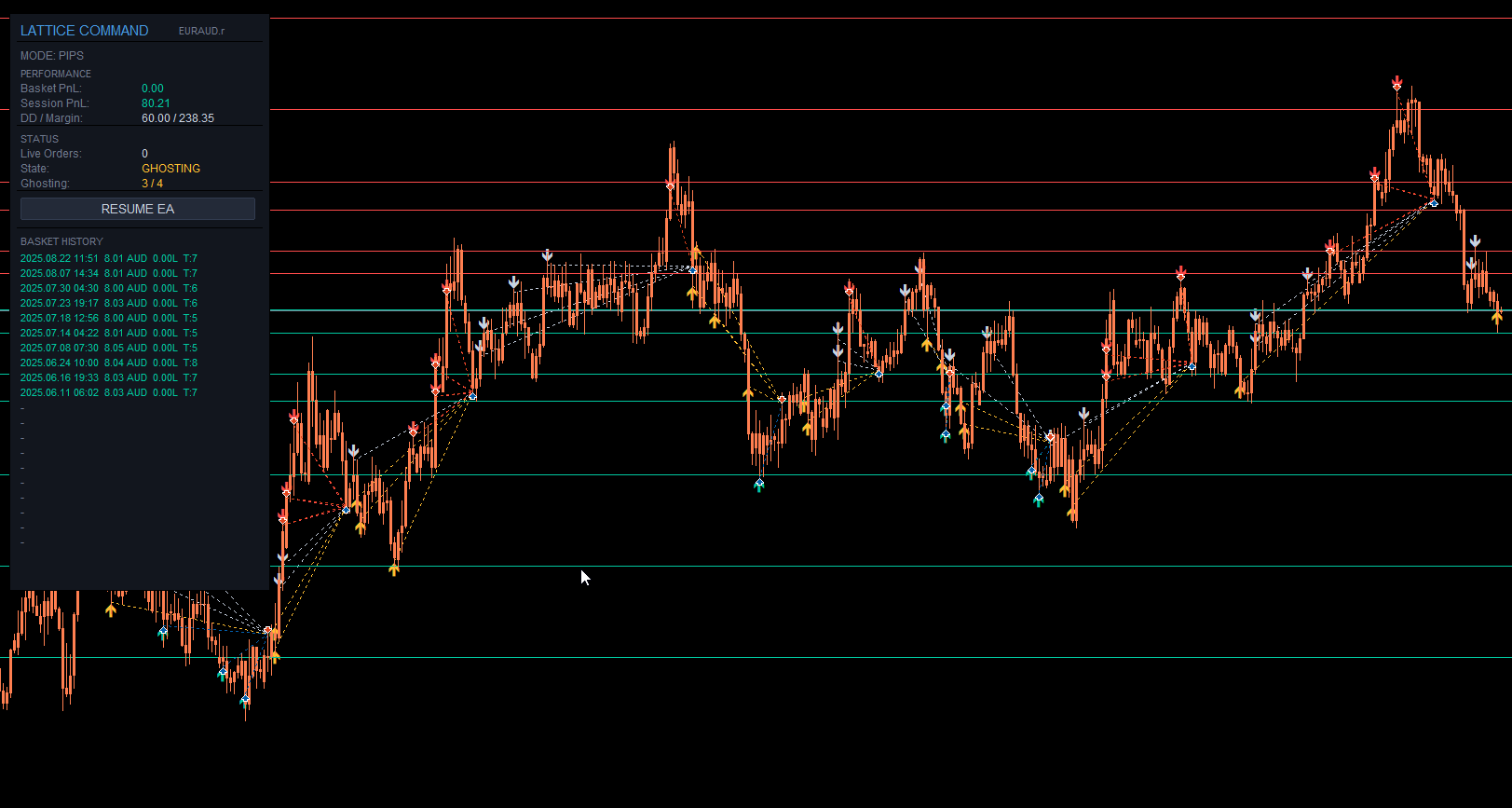
Live execution dashboard

Live execution — active basket with real-time PnL, DD/Margin, basket history, and execution state

(Haven't watched the demo yet? See Leon's Vision-tested settings running through years of live data in minutes )

Use Cases

Strategy Tester Backtesting

Transfer parameters from Vision and run proper bar-by-bar backtests with Command's full execution engine. This is where you refine trigger options — test different ghost counts, enable recross confirmation, try consolidated execution — with realistic order simulation including slippage and spread modelling.

Live Account Deployment

Production-grade architecture for real capital. Persistent state survives anything. Multi-layer safeguards protect against runaway losses. Parallel close locks in profit fast. Adaptive broker handling works across environments. This is what Command was built for.

24/7 VPS Operation

Designed for unattended remote operation where reliability is everything. Handles the inevitable VPS restarts, connection drops, and maintenance cycles. State recovery ensures seamless resumption. Push and email notifications keep you informed without requiring chart access.

Multi-Instance Deployment

Deploy across multiple accounts, instruments, or configurations with independent state persistence for each instance. Each operates autonomously via configurable magic numbers. Run conservative settings on one pair and aggressive on another — each with its own safeguards, schedules, and notifications.

Prop-Firm Deployments

Validate parameters against funded-account constraints in Vision, then deploy with Command's safeguards configured to respect daily loss limits and maximum drawdown rules. The soft stop acts as your automated guardian — liquidating before you breach evaluation thresholds.

Forward Testing

Bridge the gap between backtesting and live. Deploy on a demo account with Command's full execution engine to observe real-time behaviour, broker interaction, and state persistence before committing real capital.

Watch It Work

Get Lattice Command

Available on the official MQL5 Marketplace.

$149 USD

One-time purchase • Free updates

Buy on MQL5 Marketplace

Why the MQL5 Marketplace?

All Cave & Fire Lab products are distributed exclusively through the official MQL5 Marketplace operated by MetaQuotes. This means secure payment processing, hardware-bound licensing that protects your purchase, verified seller identity, and every product version passes automated quality checks before publication. It's the safest way to buy MT5 software.

Start with Lattice Vision™ — the free research and discovery tool. Find your parameters there, then deploy them here.

Important Notices

Software Product Disclaimer

Lattice Command™ is a software product developed and published by Cave and Fire Group Pty Ltd., a registered Australian company operating under the trading name Cave & Fire Lab. Cave and Fire Group Pty Ltd. is a software development company. We are not a financial services provider, broker, dealer, fund manager, investment adviser, or holder of an Australian Financial Services Licence (AFSL). We do not operate in the financial services industry. We make software.

No Financial Advice

Nothing in this product, its documentation, marketing materials, website content, or any associated communications from Cave and Fire Group Pty Ltd. or Cave & Fire Lab constitutes financial advice, a recommendation to trade, or a solicitation to buy or sell any financial instrument. We do not provide financial advice, trading signals, strategy recommendations, or investment guidance of any kind. All parameters, configurations, and deployment decisions are made entirely by the user. Users should seek independent professional financial advice before making any trading or investment decisions.

Use at Your Own Risk

All use of Lattice Command™ is entirely at the user's own risk. Trading financial instruments involves substantial risk of loss and is not suitable for all individuals. You should only trade with capital you can afford to lose. Past performance — whether demonstrated through backtesting, forward testing, or any other method — is not indicative of future results. No representation is being made that any account will or is likely to achieve profits or losses similar to those discussed or demonstrated.

Software Limitations & Bugs

Like all software, Lattice Command™ may contain unforeseen bugs, errors, or limitations despite rigorous development and testing. Software is inherently complex and no developer can guarantee that every possible scenario has been anticipated or that the software will operate without error in all conditions. This product is intended for users who understand and accept the inherent limitations of software, including the possibility of unexpected behaviour, calculation errors, or execution failures. The software operates within the constraints of the MetaTrader 5 platform, broker infrastructure, network connectivity, and system resources available to it. Cave and Fire Group Pty Ltd. does not guarantee uninterrupted, error-free, or fault-free operation.

Conditions Beyond Our Control

The software cannot account for, and cannot protect against, all possible market or technical conditions including but not limited to: extreme volatility, liquidity gaps, flash crashes, broker insolvency, platform outages, third-party software interference, operating system issues, hardware failures, network interruptions, regulatory changes, or any other conditions outside the direct control of the software.

Limitation of Liability

To the maximum extent permitted by applicable law, Cave and Fire Group Pty Ltd., its directors, employees, contractors, and affiliates shall not be liable for any direct, indirect, incidental, consequential, or special damages arising from the use of, or inability to use, this software. This includes but is not limited to financial losses, lost profits, trading losses, data loss, or business interruption, regardless of whether such damages were foreseeable or whether Cave and Fire Group Pty Ltd. was advised of the possibility of such damages.

User Responsibility

By purchasing and using this software, users acknowledge that they have read and understood these notices and accept all risks described herein. Users are expected to: thoroughly understand the software's functionality before deploying with real capital; test all configurations extensively in a risk-free demo environment; maintain appropriate risk management practices independently of the software; ensure their use complies with all applicable laws and regulations in their jurisdiction; and seek independent professional financial advice where appropriate.

Trademarks

Lattice Command™, Lattice Vision™, Ghosting Technology™, and Cave & Fire Lab™ are trademarks of Cave and Fire Group Pty Ltd. MetaTrader 5 and MQL5 are trademarks of MetaQuotes Ltd. All other trademarks are the property of their respective owners.
The Discovery Half

Lattice Vision

Discover it with Vision. Backtest and deploy it with Command.

View Lattice Vision

Published Fidelity Report

The Receipts. In Public.

Lattice Command is the original level-trading execution engine — Grid Trading 2.0, engineered properly. Vision and Command share one engine across two environments, and we publish the proof.

18
Configurations Tested
12 mo
MetaQuotes 1M Data
18/18
Tests Exact Match
0.00%
Aggregate Drift

When fidelity between analysis and execution matters — and it should — this is what the bar looks like.

Read the Fidelity Report →